
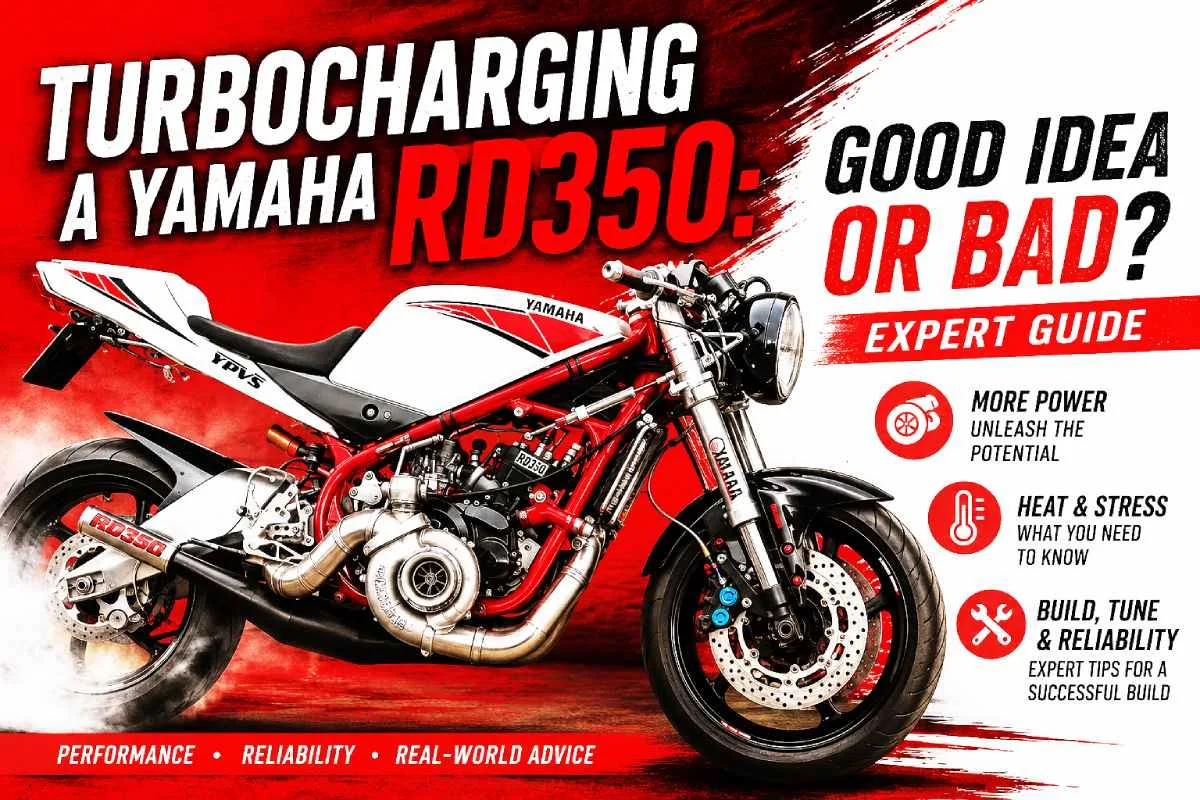
Turbocharging a Yamaha RD350: A Senior Mechanical Engineer's Deep-Dive Into Whether It's Genius or Madness
By a career mechanical engineer specializing in two-stroke engine design, tuning, and failure analysis
Introduction
Few questions ignite classic Yamaha forums, Facebook groups, and garage debates faster than: "Can I put a turbo on my RD350?" The RD350 — whether the air-cooled piston-port original (1973–1975, and its various global derivatives through the late 1970s) or the liquid-cooled, reed-valve RD350LC (1980–1995 in various markets, badged RZ350 in some regions) — remains one of the most beloved two-stroke street twins ever built. It's the machine that reportedly terrified India's motorcycling establishment in the 1980s with performance nothing else in its class could match, and decades later it still has a devoted, technically curious ownership base.
Naturally, once owners have exhausted the usual bag of tricks — expansion chambers, reed valve upgrades, big-bore kits, ignition remapping — some start eyeing forced induction as "the next level." Before going further, it's worth a quick detour through our common bike myths page, because turbocharging sits right at the intersection of "technically fascinating" and "widely misunderstood."
Here is the uncomfortable truth: turbocharging a two-stroke is not remotely comparable to turbocharging a four-stroke. This article walks through the real mechanical engineering behind the idea — the platform itself, the physics that make two-stroke forced induction uniquely difficult, documented real-world precedents, the specific failure modes you need to design around, what a competent build actually requires, and an honest final verdict.
1. Understanding the Platform: What Exactly Is an RD350?
1.1 The Family Tree
| Variant | Years | Induction | Cooling | Notable Notes |
|---|---|---|---|---|
| RD350 (piston-port) | 1973–1975 | Piston-port, crankcase induction | Air | Direct descendant of the RD250/R5 lineage |
| RD400 | 1976–1979 | Piston-port | Air | Bore increase, emissions-era detuning in US market |
| RD350LC (Mk1) | 1980–1983 | Reed valve ("Torque Induction") | Liquid | Twin front discs, monoshock rear |
| RD350LC (Mk2) / RD350F2 (YPVS) | 1983–1995 | Reed valve + YPVS power valve | Liquid | Power valve raises effective exhaust port timing at high RPM |
| RZ350 (US/Canada) | 1984–1995 | Reed valve, YPVS | Liquid | US-spec catalyzed/emissions variants |
Full spec breakdowns for every variant are available on our RD350 specifications page, and if you're working from factory data, the RD350 workshop manual is the definitive reference for crankcase, port, and clearance dimensions referenced throughout this article.
1.2 Core Specifications
| Spec | Piston-Port RD350 | RD350LC/RZ350 (Reed Valve) |
|---|---|---|
| Displacement | 347cc | 347–350cc |
| Compression ratio | ~6.6–7.0:1 | ~6.6–7.2:1 |
| Stock crank power | ~36–39 hp @ 7,000–7,500 rpm | ~47 hp @ 8,500 rpm (YPVS F2: ~59 hp) |
| Lubrication | Autolube | Autolube |
| Ignition | Points (early) / CDI (later) | CDI |
| Exhaust | Tuned expansion chambers | Tuned expansion chambers, YPVS-modulated |
These are genuinely small-displacement engines by modern standards — 347cc across two cylinders. Any serious power target means roughly doubling cylinder pressure and thermal load on components designed with 1970s metallurgy.
Critically, the RD350 shares its fundamental architecture with the Yamaha Banshee (YFZ350) ATV engine — a fact we'll return to in Section 5, since it gives us actual documented turbo data. If you ever need reference material on that engine, our Banshee YFZ350 service manual covers the closely related architecture in detail.
2. A Brief History of Motorcycle Turbocharging (And Why It's All Four-Strokes)
The early 1980s produced a genuine "turbo era": the Honda CX500 Turbo (1981), Yamaha's own XJ650 Turbo/Seca Turbo (1982), the Kawasaki 750 Turbo, and the Suzuki XN85 Turbo. Every single one was a four-stroke.
Yamaha — the same company building the RD350LC during this exact period, and covered in depth on our Yamaha history page — chose a four-stroke for its own factory turbo flagship. That historical absence is a data point worth taking seriously.
3. Two-Stroke Fundamentals: Why Boost Changes Everything
3.1 The Crankcase Is the Induction Pump
In the RD350, the crankcase itself is a positive-displacement pump — the descending piston pressurizes the trapped charge, which is then transferred into the cylinder through the transfer ports. Every part of the induction system is calibrated as a single integrated pump, which is why our basic 2-stroke tuning guide treats port timing, crankcase volume, and carburetion as one interdependent system rather than separate bolt-on variables.
3.2 Loop Scavenging and Pressure Balance
The RD350 uses Schnuerle loop scavenging, tuned around a specific crankcase compression ratio. Pressurizing the intake charge via boost, without re-engineering port timing and crankcase volume to match, produces excessive short-circuiting and shifted optimal-scavenging RPM. Our port timing calculator is a useful starting point for understanding how sensitive these relationships are even in naturally aspirated tuning.
3.3 The Expansion Chamber Is an Active Tuning Component
A two-stroke expansion chamber generates reflected pressure waves that "stuff" fresh charge back into the cylinder before the exhaust port closes — what Gordon Jennings, in his still-definitive Two-Stroke Tuner's Handbook, called the two-stroke's "built-in supercharging effect." We cover the practical side of this in our RD350 expansion chambers guide, and you can model your own chamber dimensions with our expansion chamber designer tool and cone layout generator.
A turbocharger turbine housed in the exhaust path is, acoustically and thermodynamically, a completely different animal than an open pipe. Unless the turbine and chamber are co-designed, you will detune the exact resonance mechanism these tools are built around optimizing.
3.4 Narrow Power Bands Get Narrower
Because cylinder filling depends so heavily on wave dynamics tuned to a specific RPM band, boosted two-strokes typically show narrow, aggressive power delivery once boost arrives — closer to an on/off switch than a gradual spool-up.
4. Blow-Through vs. Draw-Through: The Two Configurations
4.1 Draw-Through
Carburetor before the turbo. Simple to retrofit but causes fuel/oil puddling in the compressor housing — mechanically crude and effectively obsolete even in automotive turbo history.
4.2 Blow-Through
Clean air compressed first; fuel introduced downstream via a pressure-referenced carb box or, better, fuel injection. This is the only architecture that allows proper boost-referenced enrichment. Our carburetor tuning page and RD350 carburetor tuning guide explain baseline jetting logic that any blow-through conversion has to build on top of — and our carburetor jetting calculator is a useful starting reference point, though boosted jetting requires dyno validation well beyond these baseline numbers.
Engineering recommendation: any serious RD350 turbo build should be blow-through, realistically with throttle-body EFI and a standalone ECU, rather than fighting a boosted carburetor.
5. Real-World Precedents: What Has Actually Been Done
5.1 Detroit Diesel Series 71/92
Roots-blown, optionally turbocharged, compression-ignition two-strokes with no crankcase induction at all. Offers almost no direct engineering transferability to the RD350.
5.2 Turbocharged Two-Stroke Snowmobiles
The closest legitimate precedent: reed-valve, crankcase-scavenged twins running commercially successful blow-through turbo kits (Boondocker, MPI/Weber) — but only with factory/aftermarket EFI, purpose-designed exhaust, and knock control.
5.3 Turbocharged Yamaha Banshee (YFZ350)
The most directly relevant precedent, since this engine is closely related to the RD350LC/RZ350 family (see our Banshee service manual for the shared architecture). Documented drag builds use billet crankcases, forged pistons, aftermarket cranks/rods, dry clutch conversions, and blow-through EFI or carburetion on methanol — reportedly reaching 100–150+ hp, but treated as limited-life race engines rebuilt frequently, not street mounts.
5.4 No Documented Reliable Street Turbo RD350
There is no widely documented, long-term reliable street-ridden turbo RD350LC. This absence, combined with the OEM absence in Section 2, should weigh into your risk assessment.
6. The Autolube Problem: A Deep Technical Dive
Yamaha's Autolube meters oil based on throttle position and RPM — not manifold pressure. Under boost, a rider at partial throttle can see boost-driven cylinder pressures and heat far beyond what Autolube "thinks" it's supplying oil for. This mismatch is a direct path to piston seizure. For background on how Autolube is designed to function under normal conditions, see our maintenance guide.
Any credible turbo build must either disable Autolube for rich premix (commonly 20:1–24:1 with a quality synthetic like Motul 800 2T) or integrate boost-referenced oil metering via EFI.
7. Ignition, Detonation, and Compression Ratio
Stock points/CDI ignition has zero knock feedback. Combined with stock compression (6.6–7.2:1), even modest boost will detonate on pump fuel almost immediately. Our ignition timing and ignition modification pages cover the baseline advance curve logic that any boost-referenced retard strategy needs to start from.
A credible build requires reduced static compression via boost-specific pistons with recalculated squish clearance — use our squish clearance calculator and compression ratio calculator as starting points, alongside our dedicated squish band page for why this dimension is so critical to detonation resistance — plus high-octane race fuel and a programmable, boost-referenced ignition.
8. Structural and Mechanical Durability
Stock cranks, rods, bearings, and crankcase seals were designed around naturally aspirated cylinder pressures. The turbo Banshee community's near-universal adoption of aftermarket cranks and dry clutches for boosted builds is direct, demonstrated evidence of what's actually required. For general engine reinforcement context, see our engine modification page.
9. Turbo Lag and Power Delivery Character on a Two-Stroke
Boosted two-strokes typically layer a second, abrupt power step on top of the RD's already-nonlinear naturally aspirated power band. On a 45+-year-old chassis, this has real handling and braking implications, not just an engineering curiosity.
10. What a Properly Engineered Turbo RD350LC Actually Requires
- RD350LC/RZ350 base (reed valve, not piston-port)
- Reinforced crank/rods, new bearings and seals
- Forged, low-compression pistons with recalculated squish
- Blow-through EFI with standalone ECU
- Small, low-inertia turbo matched via compressor maps
- Purpose-designed exhaust/turbine housing
- External wastegate with boost controller
- Programmable ignition with knock-referenced retard
- Rich premix or boost-referenced oil metering
- High-octane race fuel or methanol
- Dry clutch/reinforced drivetrain
- Upgraded brakes/suspension/tires
- Extensive dyno development time
Realistic cost: $4,000–$10,000+ in parts alone, based on comparable turbo Banshee and snowmobile build costs.
11. A Hypothetical Development Process
A competent build follows: baseline NA dyno run → bottom-end reinforcement → low-boost (2–3 psi) proof of concept with rich fuel/retarded timing → incremental boost increases with EGT/wideband/knock instrumentation → iterative exhaust and fuel/ignition map refinement → extended reliability testing. This is a multi-month project for an experienced builder with dyno access, not a weekend job.
12. Pros and Cons
| Pros | Cons |
|---|---|
| Genuine novelty — very few turbo two-stroke street bikes exist | No OEM engineering precedent |
| Reed-valve architecture has proven analogues (snowmobiles, Banshee) | Turbine disrupts expansion chamber resonance unless co-designed |
| Documented related builds show serious power potential (100+ hp) | Autolube cannot respond correctly to boost load — real seizure risk |
| Reed valve's check-valve action reduces reversion vs. piston-port | Crankcase seals, bearings, rods weren't designed for boosted pressures |
| Legitimate engineering exercise for skilled builders | Piston-port RD350 is a poor candidate |
| Achievable with modern aftermarket EFI/ECU tech | Converts a classic into a race-only, short-service-life special |
| High cost ($4,000–$10,000+) relative to gains vs. NA tuning | |
| Stock ignition has no knock feedback | |
| Nonlinear power delivery raises handling/braking concerns | |
| No documented long-term reliable street example exists |
13. A Better Path? Conventional Tuning Alternatives
The RD350/RD350LC responds extremely well to conventional tuning, with dramatically less risk:
- Reed valve upgrades and matched expansion chambers — see our RD350 expansion chambers guide
- YPVS power valve refinement — our YPVS tuning secrets guide covers this in depth
- Comprehensive performance mods — the full roadmap is in our RD350 performance mods and tuning guide and general more power page
- Big-bore kits and modern CDI ignition with a properly mapped advance curve
- Careful port timing and squish optimization — reference A. Graham Bell's Two-Stroke Performance Tuning alongside our torque and horsepower page for understanding how these changes actually translate to usable power
These approaches can realistically bring a well-built RD350LC into the 65–75 hp range reliably, on pump fuel — for full context on what stock and modified performance actually looks like, see our RD350 speed and performance article.
14. Verdict: Good Idea or Bad Idea?
As a street modification: bad idea. Crankcase-scavenging physics working against pressurized induction, near-certain disruption of tuned exhaust resonance, Autolube's inability to respond to boost load, and period-correct metallurgy stack the odds heavily against reliable operation.
As a dedicated, purpose-built project by an experienced builder with EFI skills and dyno access: legitimate and interesting. The turbo Banshee and turbo snowmobile communities have proven this architecture can handle forced induction reliably when every supporting system is redesigned around it.
Professional recommendation: for roughly 95% of owners, conventional tuning via the resources linked in Section 13 delivers a far better risk-to-reward ratio. For the remaining 5% with real fabrication and tuning skills, this is a fascinating, under-explored engineering project.
FAQ
Q: Has anyone successfully turbocharged an RD350?
A: No widely documented, long-term reliable street example exists. The closest precedent is the turbocharged Yamaha Banshee (YFZ350) drag scene — see our Banshee service manual for the shared engine architecture.
Q: Can I just bolt a turbo onto my RD350's exhaust and carb?
A: No — without addressing compression, boost-referenced fueling, ignition retard, and oiling, failure is highly likely within one or two heat cycles.
Q: Is the reed-valve RD350LC better suited to turbocharging than the piston-port RD350?
A: Yes, significantly, due to the reed valve's natural check-valve action against reversion.
Q: Will a turbo hurt the RD350's exhaust expansion chamber tuning?
A: Almost certainly — see our expansion chamber guide and expansion chamber designer tool to understand how precisely these systems are tuned.
Q: Does stock Autolube work under boost?
A: Not reliably — it references throttle position and RPM, not manifold pressure or actual load.
Q: What's a safer way to get more power from an RD350?
A: Reed valve upgrades, matched expansion chambers, YPVS refinement, and CDI ignition — see our performance mods guide and more power page.
Q: Why didn't Yamaha ever build a factory turbo RD350?
A: Every factory motorcycle turbo of the era — including Yamaha's own XJ650 Turbo — was a four-stroke, reflecting the far greater complexity of pressurizing a crankcase-scavenged two-stroke.
Related Reading & Tools on RD350.info
Guides: Expansion Chambers · Carburetor Tuning · YPVS Tuning Secrets · Performance Mods · RD350 Speed & Performance
Reference Pages: Specifications · Squish Band · Ignition Timing · Torque & Horsepower · Basic 2-Stroke Tuning
Tools: Compression Ratio Calculator · Squish Clearance Calculator · Expansion Chamber Designer · Port Timing Calculator
Manuals & References: RD350 Workshop Manual · Two-Stroke Tuner's Handbook · Yamaha Banshee YFZ350 Service Manual